
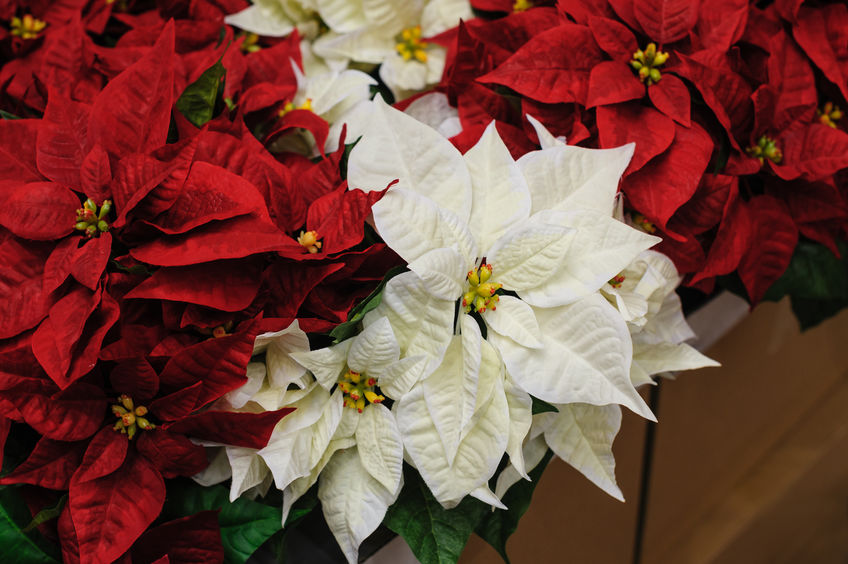
Here in America, the winter color palettes are heavily influenced by shades we commonly associate with Christmas- red, green, and white. And so, the season’s most popular plants tend to follow suit. …Or is it the other way around?
Did winter get its color assignment based on what nature herself provides most abundantly?
We’ll let you decide which came first, as you explore our fun facts about the classic winter plants that stay green in winter.
Evergreen Plants
With the term “evergreen,” people conjure an image of a towering pine or spruce tree, with thin fragrant needles. Depending on the region or time of year, we envision a forest, a single Christmas tree, or perhaps the towering live oak. But true to their name, evergreens are any plant whose leaves remain green year-round. They rarely lose their foliage, though anyone who’s had a pine tree knows they’ll litter your yard (or your living room at Christmas!) with a prickly sprinkle of yellowing needles. Evergreens are trees, shrubs, or even a smaller plant. In fact, many don’t know that succulents- such as cacti and aloe vera- are also evergreens. Here are a few common types:- Conifers, such as spruce, pine, and red cedar, are what people think of when talking about evergreens. Famous for their stately shape, their cones, and their crisp fragrance, conifers are what you’ll see when you visit the lot to purchase a live Christmas tree.
- Angiosperms, are plants who produce seeds inside small pods. They are classed as evergreens. The well-loved and fragrant. Eucalyptus is one example.
- Succulents such as agave, aloe, and haworthia make fantastic indoor evergreens. Due to their plump, juice-filled leaves, they can withstand a decent amount of neglect and still- that’s right- stay green.
- Clubmosses is the last thing you’d expect on a list of attractive evergreens. As a close cousin to ferns, many varieties are quite striking. Unlike common “carpet moss,” some species of clubmoss such as stag’s horn and lycopodi produce tall, bright green bristly stalks.
- Holly bushes, live oak trees, ginkgo trees, and several others are also evergreens. Some are gymnosperms, meaning they produce seeds without fruit (this includes conifers). Others are classed as evergreens simply because they include a broad variety of species whose leaves are always green.